Engineering
How AI Is Changing Hiring for Software Engineers
Artificial intelligence is reshaping how companies hire software engineers. Learn why resumes and coding interviews are no longer enough, and how engineering-first hiring is becoming the new standard.
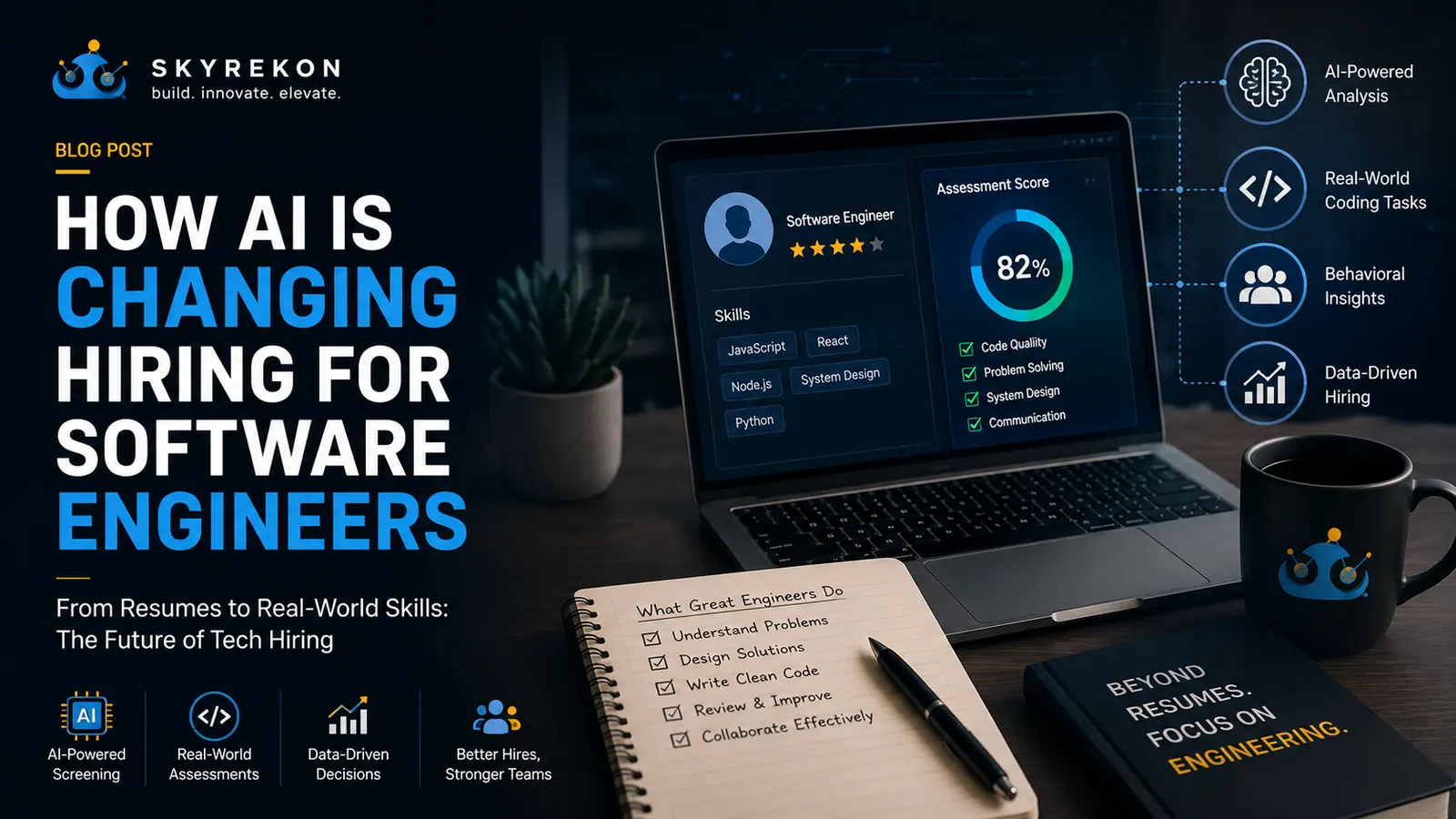
Artificial intelligence has fundamentally changed software development.
Developers now have access to tools like GitHub Copilot, Cursor, Claude, ChatGPT, Gemini, and countless specialized AI assistants capable of generating code, explaining complex concepts, writing tests, and even fixing bugs.
As a result, writing code is no longer the biggest challenge.
Understanding software engineering has become the real differentiator.
This shift is forcing companies to rethink one of the most important parts of building great products:
How do you actually hire great software engineers?
AI Didn't Replace Engineers
A common misconception is that AI will replace software developers.
The reality is much more nuanced.
AI has become an incredibly powerful productivity tool, but it still depends on the engineer using it.
Two developers can receive the exact same AI response and produce completely different outcomes.
One developer blindly copies generated code.
The other understands the problem, reviews the solution, improves it, and ships reliable software.
The difference isn't AI.
The difference is engineering.
The Resume Is Becoming Less Valuable
For years, hiring decisions heavily relied on resumes.
Recruiters evaluated candidates based on:
- Previous companies
- College degrees
- Years of experience
- Technology lists
- Personal projects
While resumes still provide useful background information, they reveal very little about a candidate's actual engineering ability.
Questions remain unanswered:
- Can they debug production issues?
- Can they understand unfamiliar code?
- Can they work with AI effectively?
- Can they review generated code?
- Can they communicate technical decisions?
A resume simply cannot answer these questions.
Traditional Coding Interviews Have Problems
Most software engineering interviews still involve solving algorithmic questions on a whiteboard or coding platform.
These interviews often focus on:
- Binary trees
- Linked lists
- Dynamic programming
- Graph algorithms
While these topics have educational value, they rarely reflect the work engineers perform every day.
Most engineers spend their time:
- Reading existing code
- Debugging issues
- Reviewing pull requests
- Understanding business requirements
- Improving performance
- Fixing production bugs
- Writing maintainable software
Modern engineering work looks very different from solving isolated algorithm puzzles.
AI Has Changed the Interview Room
Today, candidates can often use AI during take-home assignments.
They can ask AI to:
- Generate complete applications
- Solve interview questions
- Write tests
- Explain frameworks
- Generate APIs
- Refactor code
This raises an important question:
If everyone has access to the same AI, how do you identify the better engineer?
The answer isn't banning AI.
It's changing what you measure.
Companies Need to Evaluate Engineering Thinking
Modern hiring should evaluate how candidates think, not just what they type.
Instead of asking:
"Can you implement quicksort?"
Companies should ask:
- Can you investigate a production bug?
- Can you understand an unfamiliar codebase?
- Can you identify architectural problems?
- Can you explain technical trade-offs?
- Can you improve existing software?
- Can you collaborate with AI effectively?
These skills are much closer to real software development.
AI Is Becoming Part of the Engineering Workflow
The best companies no longer view AI as cheating.
Instead, AI is becoming another engineering tool—similar to an IDE, debugger, or documentation.
Great engineers use AI to:
- Generate initial implementations
- Explore unfamiliar technologies
- Write boilerplate code
- Review approaches
- Generate documentation
- Improve productivity
But they also:
- Validate outputs
- Review every change
- Understand generated code
- Fix incorrect assumptions
- Test thoroughly
The ability to collaborate with AI is becoming a valuable engineering skill.
Real Projects Reveal More Than Coding Challenges
Imagine two candidates.
Both complete a coding interview successfully.
One struggles when asked to investigate an unfamiliar production bug.
The other immediately:
- Reads the logs
- Identifies the failing component
- Understands the architecture
- Uses AI to accelerate debugging
- Verifies the solution
- Explains the root cause
Which candidate would you trust to maintain a production system?
Real engineering scenarios reveal strengths that traditional interviews often miss.
The Rise of Engineering Assessments
Forward-thinking companies are moving toward project-based assessments.
Instead of asking candidates to solve isolated problems, they evaluate how engineers perform in realistic environments.
Examples include:
- Fixing production bugs
- Implementing requested features
- Reviewing existing pull requests
- Improving application performance
- Debugging failing test suites
- Refactoring legacy code
- Understanding documentation
These assessments measure practical engineering skills rather than memorized interview techniques.
Soft Skills Matter More Than Ever
As AI handles more repetitive programming work, human skills become increasingly valuable.
Companies now place greater emphasis on:
- Communication
- Collaboration
- Problem-solving
- System thinking
- Ownership
- Curiosity
- Continuous learning
Technical ability remains essential, but engineering is ultimately a collaborative discipline.
What Companies Should Change
Organizations hiring software engineers should reconsider how they evaluate candidates.
Instead of relying exclusively on resumes and algorithm interviews, combine multiple signals.
Consider assessing:
- Engineering projects
- Code reviews
- Debugging ability
- Architectural thinking
- Communication
- Collaboration
- AI-assisted workflows
- Practical decision-making
The goal isn't to identify who writes the fastest code.
It's to identify who can build reliable software.
What Developers Should Focus On
Developers preparing for the future should spend less time memorizing interview tricks and more time developing practical engineering skills.
Focus on:
- Reading large codebases
- Building complete applications
- Debugging production issues
- Understanding architecture
- Writing maintainable code
- Reviewing pull requests
- Learning cloud infrastructure
- Using AI effectively
The strongest engineers aren't those who avoid AI.
They're the ones who know when to trust it—and when not to.
The Future of Technical Hiring
Hiring is moving away from evaluating code generation and toward evaluating engineering judgment.
In the coming years, companies are likely to place greater emphasis on:
- Production-style engineering assessments
- AI-assisted development workflows
- Portfolio-based evaluation
- Real-world project experience
- Continuous technical growth
Engineers who understand systems, architecture, debugging, collaboration, and software quality will continue to stand out regardless of how advanced AI becomes.
Final Thoughts
Artificial intelligence hasn't eliminated the need for software engineers.
It has simply changed what makes a great engineer.
The future belongs to professionals who combine technical fundamentals, sound engineering judgment, and AI-assisted productivity to build reliable software.
For businesses, this means modernizing hiring practices to evaluate real engineering capability.
For developers, it means investing in practical skills that extend beyond writing code.
The engineers who thrive in the AI era won't be those competing against AI.
They'll be the ones who know how to work alongside it.
Looking to Build Better Engineering Teams?
At Skyrekon, we build AI-native software products, developer platforms, enterprise systems, and engineering assessment solutions that help organizations evaluate real-world software engineering skills—not just coding ability.
Whether you're building an internal engineering platform, modernizing your hiring process, or developing AI-powered developer tools, we'd love to help turn your ideas into production-ready software.
Tags
- AI
- Software Engineering
- Hiring
- Recruitment
- Developer Assessment
- Engineering
Building something similar?
Skyrekon partners with teams on AI-native products, platforms, and engineering systems — from discovery through production.