Product Development
Why Every Startup Should Build an MVP Before Scaling
Learn why successful startups prioritize launching a Minimum Viable Product (MVP), how it reduces risk, validates ideas faster, and saves engineering costs.
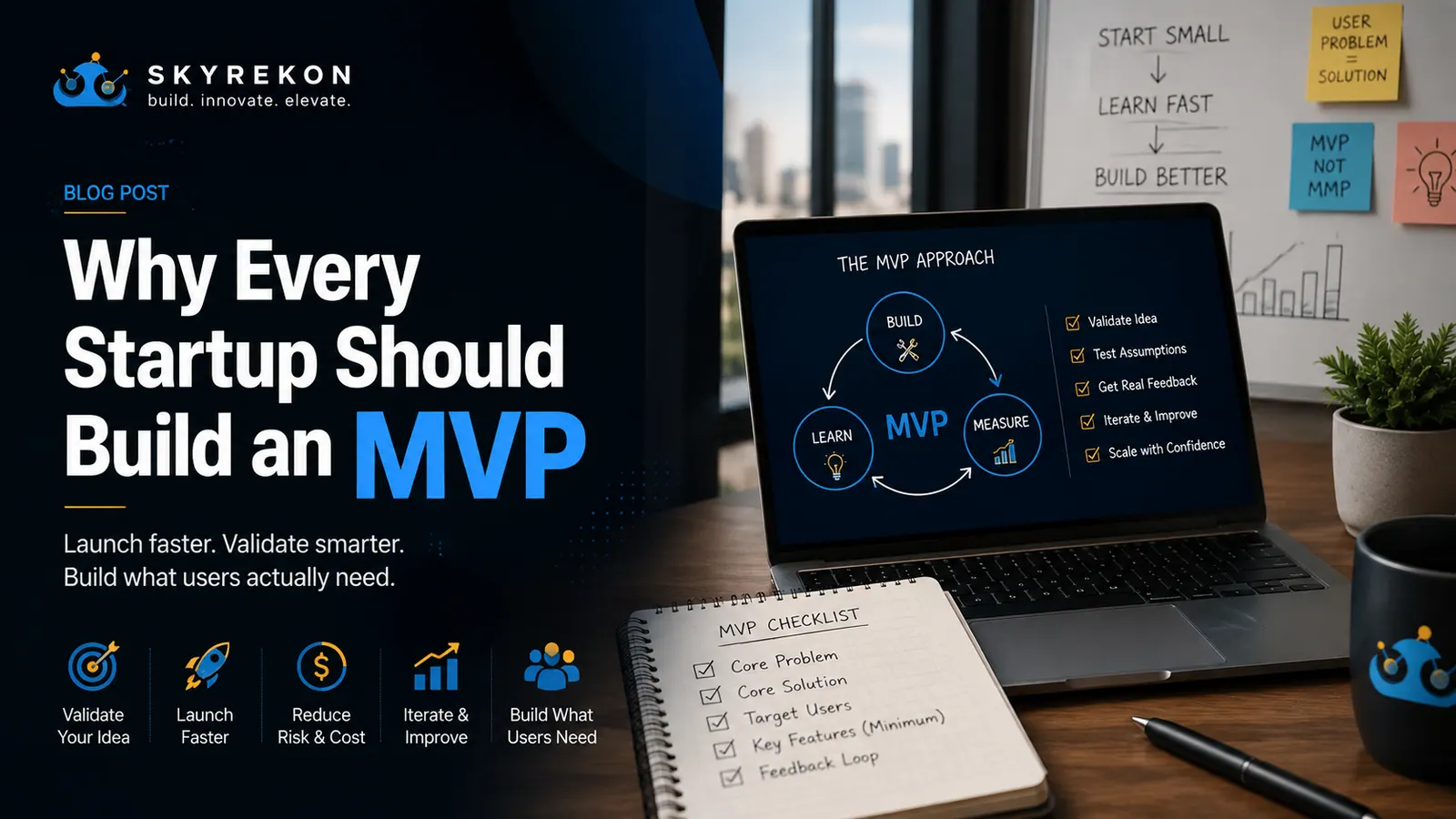
Building a successful software product isn't about launching with every feature imaginable. It's about solving one important problem exceptionally well.
Yet countless startups spend months—or even years—building feature-rich platforms before ever talking to real customers. The result? Delayed launches, exhausted budgets, and products nobody truly needs.
The companies that win aren't necessarily the ones with the biggest engineering teams.
They're the ones that learn the fastest.
That's exactly why building a Minimum Viable Product (MVP) has become the standard approach for modern product development.
What Is an MVP?
An MVP (Minimum Viable Product) is the simplest version of your product that delivers real value to users while validating your core assumptions.
An MVP isn't:
- A prototype
- A demo
- A half-finished application
- A buggy product
Instead, it's a production-ready solution focused on solving one primary problem.
Think of it as:
Build less. Learn faster. Improve continuously.
Why Most Startups Fail Before They Launch
Many founders begin with a vision that looks something like this:
- User authentication
- Dashboards
- Admin panel
- AI integration
- Analytics
- Notifications
- Mobile apps
- Payment gateway
- Marketplace
- Reports
- Automation
After six months...
The product still isn't live.
No customers.
No feedback.
No revenue.
Every month spent building without validation increases business risk.
The Real Goal Isn't Building Software
The goal is answering one question:
Will someone actually pay for this?
Until that question has been answered, every additional feature increases uncertainty.
Your MVP exists to reduce that uncertainty.
Benefits of Building an MVP
1. Validate the Market Early
Instead of guessing what customers want, launch quickly and let real users guide future development.
Real feedback always beats assumptions.
2. Reduce Development Costs
Building fewer features means:
- Smaller engineering budget
- Faster delivery
- Lower maintenance costs
- Easier testing
Every feature you don't build saves future engineering effort.
3. Launch Months Earlier
Many startups delay launch waiting for perfection.
Successful startups optimize for learning.
Launching three months earlier often creates a much bigger competitive advantage than shipping twenty additional features.
4. Attract Investors More Easily
Investors care less about polished interfaces and more about evidence.
Metrics such as:
- Active users
- Revenue
- Retention
- Engagement
- Customer feedback
are significantly more valuable than a long feature list.
An MVP helps generate these metrics quickly.
5. Build the Right Product
Many founders confuse customer requests with customer problems.
An MVP helps identify:
- Which features users actually use
- Which workflows create value
- Which assumptions were wrong
- What customers are willing to pay for
What Should Be Included in an MVP?
A good framework is:
Must Have
Core functionality required to solve the main problem.
Example:
Food delivery app:
- Restaurant listings
- Menu
- Cart
- Checkout
Nice to Have
Useful improvements that can wait.
Examples:
- Coupons
- Loyalty points
- Reviews
- Favorites
Future Features
Ideas that should only be built after customer validation.
Examples:
- AI recommendations
- Gamification
- Advanced analytics
- Referral systems
- Social features
Common MVP Mistakes
Building Too Many Features
Every feature adds:
- Development time
- QA effort
- Technical debt
- Maintenance cost
Ask yourself:
Would customers still pay without this feature?
If yes, don't build it yet.
Waiting for Perfection
Perfect products don't exist.
Successful products evolve continuously.
Customers would rather have:
- Useful today
than
- Perfect next year.
Ignoring Customer Feedback
The purpose of launching early is learning.
Talk to users.
Watch them use your product.
Identify friction.
Improve.
Repeat.
Overengineering
Many startups spend weeks optimizing systems that only have a handful of users.
Don't solve scaling problems before you have customers.
Optimize after demand exists.
A Practical MVP Roadmap
Phase 1 — Discovery
- Understand the problem
- Research competitors
- Define your target audience
- Validate demand
Phase 2 — Product Design
- User flows
- Wireframes
- Core feature list
- Technical planning
Phase 3 — MVP Development
Build only essential functionality.
Focus on:
- Performance
- Reliability
- Simplicity
Phase 4 — Launch
Release to real users.
Collect:
- Feedback
- Analytics
- Feature requests
- Bugs
Phase 5 — Iterate
Use data—not assumptions—to prioritize future development.
This is where successful products begin to separate themselves.
Real Examples of MVP Thinking
Many well-known companies started with remarkably simple products.
Instead of launching massive platforms, they focused on solving one problem extremely well before expanding.
Their first versions were intentionally limited—but valuable enough for customers to use.
Once demand was validated, they invested in scaling features, infrastructure, and growth.
The lesson is simple:
You don't need every feature.
You need proof that customers care.
Signs Your Startup Is Ready to Scale
You're ready to move beyond the MVP when you consistently see:
- Growing user adoption
- Positive customer feedback
- Repeat usage
- Clear product-market fit
- Stable revenue
- A validated roadmap
At that point, investing in advanced features becomes much less risky.
Final Thoughts
An MVP isn't about building less because you lack ambition.
It's about building smarter.
Every successful software company starts by solving one meaningful problem well before attempting to solve ten others.
If you're building a startup today, focus on learning—not perfection.
Launch earlier.
Listen closely.
Improve continuously.
That's how great products are built.
Need Help Building Your MVP?
At Skyrekon, we partner with startups to design, build, and launch scalable MVPs that help validate ideas quickly without unnecessary engineering overhead.
Whether you're starting with an idea, wireframes, or an existing prototype, our team can help you move from concept to launch with a product designed for future growth.
Tags
- MVP
- Startup
- Product Development
- SaaS
- Software Engineering
- Product Strategy
Building something similar?
Skyrekon partners with teams on AI-native products, platforms, and engineering systems — from discovery through production.