Software Architecture
Monolith vs Microservices: Which Architecture Should You Choose?
Monolith or Microservices? Learn the advantages, disadvantages, and how to choose the right software architecture for your business.
One of the first architectural decisions every software team faces is deceptively simple:
Should we build a monolith or adopt microservices?
The answer isn't "microservices."
It also isn't "monolith."
The best architecture depends entirely on where your product is today—and where it's going tomorrow.
Unfortunately, many startups adopt microservices because companies like Netflix, Uber, and Amazon use them.
What they forget is that those companies started with monoliths.
Let's explore when each architecture makes sense.
What Is a Monolith?
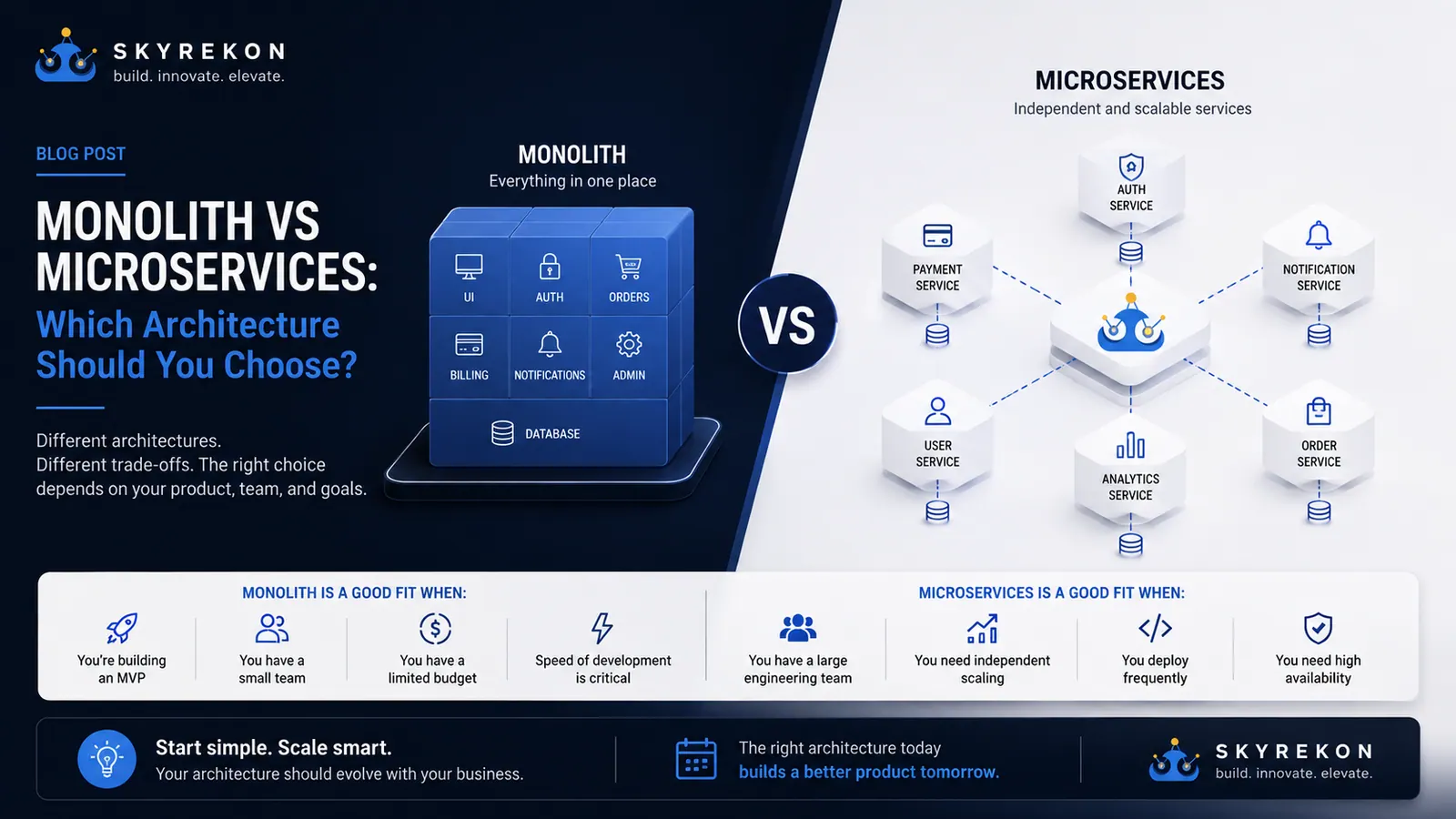
A monolithic application contains everything in a single codebase.
Frontend.
Backend.
Authentication.
Payments.
Notifications.
Admin Panel.
Everything is deployed together.
Example:
Application
├── Authentication
├── Dashboard
├── Orders
├── Billing
├── Notifications
└── Admin
One deployment.
One database.
One project.
Advantages of a Monolith
Faster Development
Developers only work in one repository.
There is less setup.
Less infrastructure.
Fewer deployment pipelines.
Perfect for startups.
Easier Debugging
Need to trace an API?
Everything exists inside one application.
Logs are centralized.
Dependencies are simple.
Lower Infrastructure Cost
A monolith usually requires:
- One server
- One deployment pipeline
- One database
That's significantly cheaper than managing multiple services.
Faster MVP Development
When you're validating an idea,
speed matters more than scalability.
Launching six months earlier is often more valuable than perfect architecture.
When Monoliths Become Difficult
As products grow:
- Codebases become larger
- Deployments become slower
- Teams begin conflicting
- Scaling becomes harder
Eventually:
changing one feature risks affecting another.
This is when teams start considering microservices.
What Are Microservices?
Microservices divide an application into independent services.
Each service owns one responsibility.
Example:
Authentication Service
↓
Payment Service
↓
Notification Service
↓
Project Service
↓
Analytics Service
Every service can:
- deploy independently
- scale independently
- have its own database
- use different technologies
Advantages of Microservices
Independent Scaling
Imagine your payment system receives heavy traffic.
Only the payment service needs more servers.
Everything else remains unchanged.
Lower infrastructure costs.
Better performance.
Faster Team Collaboration
Large organizations often have:
- Authentication Team
- Billing Team
- AI Team
- Platform Team
Each team deploys independently.
Nobody waits for another department.
Better Fault Isolation
If Notifications fail...
Payments continue working.
Authentication continues working.
The platform remains online.
Failures become isolated.
Technology Flexibility
One service might use:
- Go
- Node.js
- Python
Another might use:
- Rust
- Java
- .NET
Teams choose the best technology for each problem.
The Hidden Cost of Microservices
Many engineering teams underestimate the complexity.
Microservices introduce:
- Service discovery
- API gateways
- Distributed tracing
- Monitoring
- Logging
- Container orchestration
- Message queues
- Network latency
- Versioning
- CI/CD pipelines
You're no longer managing one application.
You're managing an ecosystem.
When Should You Choose a Monolith?
A monolith is usually the best choice when:
- Building an MVP
- Small engineering team
- Under 10 developers
- Product-market fit isn't validated
- Budget matters
- Fast iteration is critical
For most startups,
this is the correct answer.
When Should You Choose Microservices?
Microservices become valuable when:
- Millions of users
- Large engineering organization
- Independent product teams
- High deployment frequency
- Different scaling requirements
- High availability is critical
If you're asking whether you need microservices...
you probably don't.
Hybrid Architecture
Many successful companies use a hybrid approach.
Start here:
Monolith
Then extract:
Authentication
↓
Payments
↓
AI Engine
↓
Notifications
Only split services when there is a measurable benefit.
This keeps complexity manageable.
Common Mistakes
Starting With Microservices
The biggest mistake.
Many startups spend months building infrastructure instead of building products.
Splitting Too Early
Don't create services because they're fashionable.
Create services because they solve operational problems.
Ignoring Team Size
Five developers don't need fifteen microservices.
Communication becomes harder than coding.
Multiple Databases Too Soon
One database is usually enough.
Adding distributed data consistency introduces unnecessary complexity.
How We Decide at Skyrekon
Every architecture decision starts with business goals.
We evaluate:
- Team size
- Expected growth
- Product complexity
- Deployment frequency
- Infrastructure budget
- Performance requirements
- Future scalability
Sometimes a monolith is the smartest solution.
Sometimes microservices are necessary.
Good engineering isn't about following trends.
It's about making the right trade-offs.
A Simple Decision Framework
Choose a Monolith if:
- Startup
- MVP
- Small team
- Fast iteration
- Limited budget
Choose Microservices if:
- Large engineering teams
- Multiple products
- Independent scaling
- Enterprise workloads
- High deployment frequency
Final Thoughts
Architecture should evolve with your business.
The worst architecture isn't a monolith.
It isn't microservices.
It's choosing complexity before you've earned it.
Start simple.
Build value.
Scale when the business—not hype—demands it.
Building a Scalable Product?
Whether you're launching an MVP or designing an enterprise platform, Skyrekon helps businesses choose the right architecture for today while preparing for tomorrow.
Let's build software that scales with your ambitions—not against them.
Tags
- Software Architecture
- Microservices
- Monolith
- Backend
- Engineering
Building something similar?
Skyrekon partners with teams on AI-native products, platforms, and engineering systems — from discovery through production.